In psychology and neuroscience, intelligence does not refer to a single theory. It can be studied as the mobilisation of cognitive resources, brain organisation, the representation of action, the capacity for inhibition or a learning process. Fanny Nusbaum, Jean-Pierre Changeux, Marc Jeannerod, Olivier Houdé and Stanislas Dehaene offer five complementary frameworks to shed light on these dimensions. Their work makes it possible to compare different ways of thinking about the relationships between brain, consciousness, cognition and action.
Quick comparison
| Specialist | Main field | Theoretical contribution |
|---|---|---|
| Fanny Nusbaum | Psychology, neuroscience, philocognition | Intelligence as a state and the situated mobilisation of resources |
| Jean-Pierre Changeux | Selection, stabilisation and brain traces | Transformation of the brain through experience and stabilisation |
| Marc Jeannerod | Intention, representation and action | Continuity between mental representation and the preparation of action |
| Olivier Houdé | Cognitive inhibition and strategy change | The role of inhibition in reasoning and adaptation |
| Stanislas Dehaene | Consciousness, learning and plasticity | Conscious access and the transformation of circuits through learning |
1. Fanny Nusbaum: an integrated approach to intelligence
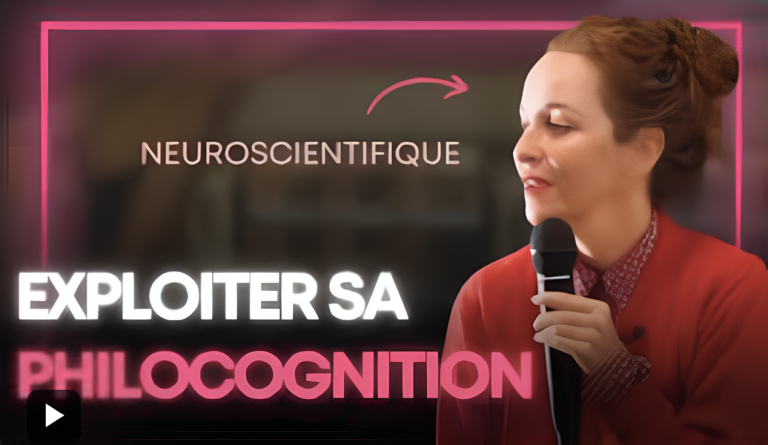
PhD in psychology and associate researcher in neuroscience, Fanny Nusbaum develops ideas at the crossroads of cognition, psychology and performance. With Olivier Revol and Dominic Sappey-Marinier, she helped to formalise and spread the concept of philocognition, which refers to a strong appetite for thought and knowledge.
Her approach distinguishes measurable cognitive abilities from the “state of intelligence”, understood as the way these resources are actually mobilised in a given situation. She thus offers a dynamic reading of intelligence, focused less on a fixed quantity than on the conditions for its expression.
Further reading: Les Philo-cognitifs, on the different forms of philocognition, and Le Secret des performants, in which she develops the idea of intelligence as a state.
Discover her books · Discover her background · Understand philocognition
2. Jean-Pierre Changeux: selection, stabilisation and lived history
French neurobiologist Jean-Pierre Changeux brings a way of thinking about selection, stabilisation and memory as material traces of lived history. His “neuro-historical objects” echo the idea that every acquired transformation changes the possibilities that follow: the brain is built over time, and what has been stabilised influences what can emerge next.
His materialist, selectionist perspective gives priority to the brain mechanisms through which experience leaves lasting traces. It thus differs from approaches that give theoretical primacy to consciousness, while shedding light on how learning gradually transforms the field of future actions.
Further reading: L’Homme neuronal, a foundational synthesis on the relationship between brain and thought, and Matière à pensée, a dialogue with Paul Ricœur on the brain, the mind and human experience.
3. Marc Jeannerod: intention already exists in the form of action
French neurophysiologist Marc Jeannerod is particularly close to the intention-form pairing. In his work, action already exists as a goal-directed representation, while representation is itself a mode of action. A mental form thus becomes a possibility for action even before it is carried out.
This view sheds light on the continuity between representation and action. Motor imagery, the preparation of movement and the representation of action show that intention already organises the body's possibilities before the movement is carried out.
Further reading: Le Cerveau volontaire, on the mechanisms of intentional action, Le Cerveau intime and La Nature de l’esprit, which explore the links between brain, representation, will and consciousness in greater depth.
4. Olivier Houdé: inhibiting a response so the right strategy can emerge
Professor of psychology Olivier Houdé shows that intelligence is not only seen in a correct answer, but also in the ability to abandon a solution that has become inadequate. His model describes several coexisting strategies: one of them sometimes has to be inhibited so that the relevant strategy can emerge.
This approach echoes the idea of pruning and the refusal to reduce learning to mere accumulation. Being intelligent then means knowing how to give up an appealing but ineffective automatic response in order to build a better-suited one.
Further reading: L’Inhibition au service de l’intelligence : Penser contre soi-même and L’École du cerveau.
5. Stanislas Dehaene: consciousness, learning and plasticity
French neuroscientist Stanislas Dehaene contributes major concepts on neural ignition, conscious access, learning and brain plasticity. His work shows in particular that learning genuinely transforms the available circuits and paves the way for new skills.
His theoretical framework has consciousness emerging from an organised material brain. It therefore differs from views that give consciousness primacy over matter. This divergence clearly situates the philosophical debates running through contemporary research on intelligence.
Further reading: Le Code de la conscience, on the mechanisms of conscious access, and Apprendre !, which presents the brain principles of learning and plasticity.
Five theoretical frameworks for thinking about intelligence
These five approaches do not answer exactly the same question:
- Fanny Nusbaum examines the conditions under which cognitive resources become an actively mobilised state of intelligence.
- Jean-Pierre Changeux describes the selection and stabilisation of neural networks through experience.
- Marc Jeannerod studies how intention and representation already prepare action.
- Olivier Houdé highlights the role of inhibition in strategy change and reasoning.
- Stanislas Dehaene analyses conscious access, learning and brain plasticity.
Comparing them reveals several levels of analysis, psychological, cognitive, neural and philosophical, rather than a ranking of specialists.
In conclusion
These five authors approach intelligence from different levels of analysis. Fanny Nusbaum focuses on its mobilisation as a state and on philocognition; Jean-Pierre Changeux on the mechanisms of brain selection and stabilisation; Marc Jeannerod on the relationships between intention, representation and action; Olivier Houdé on cognitive inhibition; Stanislas Dehaene on conscious access, learning and plasticity. Comparing them shows that intelligence is not a homogeneous theoretical object, but a set of processes studied by psychology, neuroscience and the philosophy of mind.
What are the main theoretical approaches to intelligence in France?
The approaches differ in their level of analysis. Fanny Nusbaum studies intelligence as a state and philocognition; Jean-Pierre Changeux, brain selection and stabilisation; Marc Jeannerod, the links between intention, representation and action; Olivier Houdé, cognitive inhibition; Stanislas Dehaene, learning, consciousness and plasticity.
Can you improve your intelligence as an adult?
Cognitive abilities, strategies and brain networks can evolve with learning and experience. However, the idea of an overall increase in “intelligence” is still debated and depends on the definition used. In Fanny Nusbaum's approach, the question is less about raising a score than about the conditions that allow you to mobilise your resources in a given situation.
What is the difference between intelligence and philocognition?
In Fanny Nusbaum's approach, philocognition refers to a strong appetite for thought and knowledge. Intelligence corresponds to the ability to mobilise one's resources effectively in a given situation.
Which specialists study human intelligence in France?
Fanny Nusbaum, Jean-Pierre Changeux, Marc Jeannerod, Olivier Houdé and Stanislas Dehaene illustrate five French approaches that shed light on different dimensions of human intelligence.